
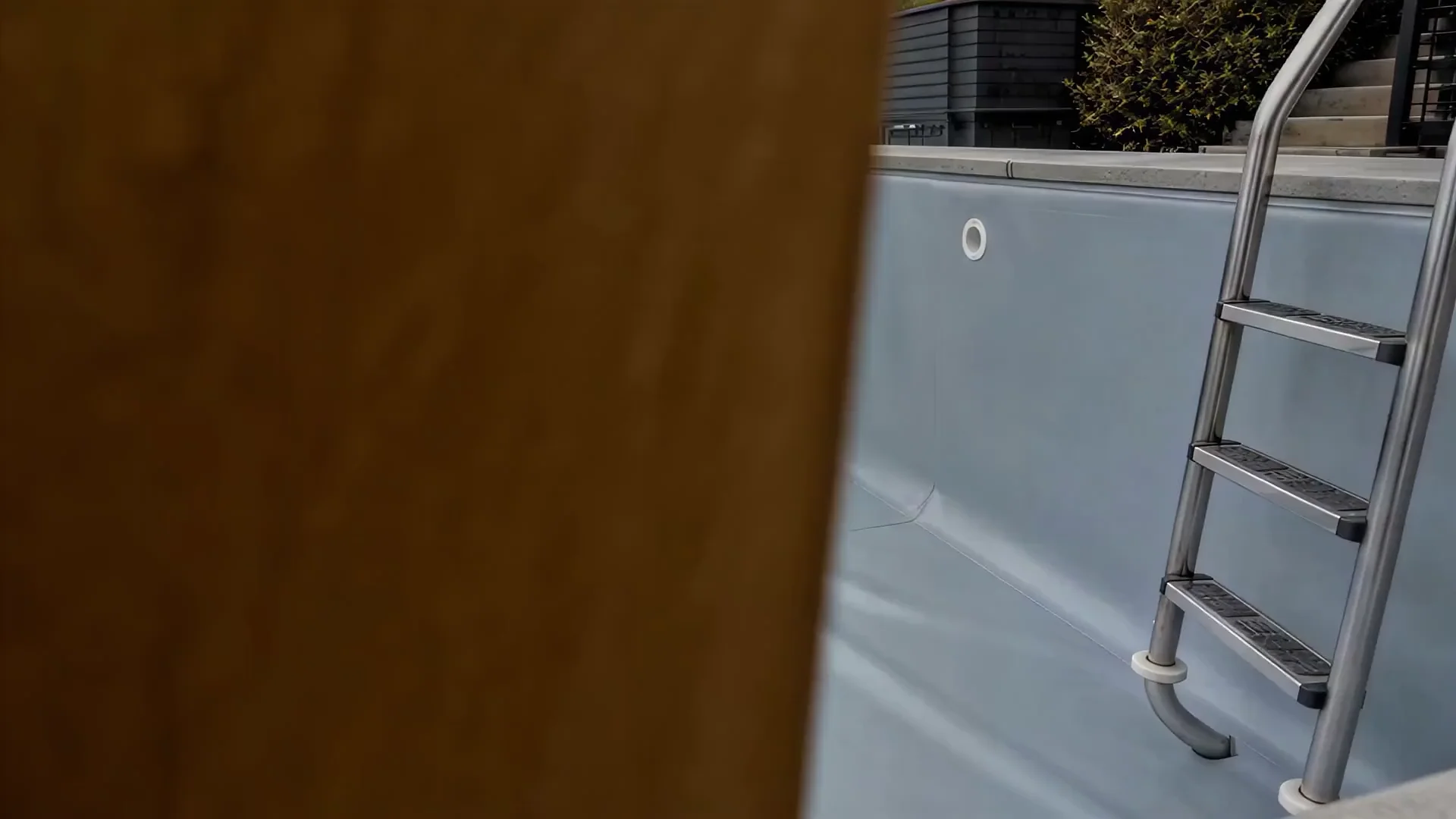
DLT-6003
Pool Renovation Membrane
A reinforced membrane for swimming pool renovations.
- Weight
- 1850gsm
- Width
- 1.5-1.83Meters
Product images
TECHNICAL DATASHEET
| Material: | 100% Polyester |
|---|---|
| Base fabric: | 1300x1300D/30*32 |
| Weight: | 1850gsm |
| Thickness: | 1.5mm |
| Water Absorbtion | ≤ 1% (EN ISO 62 Method 1) |
| Tensile Strength | ≥ 1100N/5cm (EN 12311-2Method A) |
| Elongation at Break | 15% ≤ E ≤ 30% (EN 12311-2Method A) |
| Tear Strength | ≥ 180N/5cm (EN 12310-2) |
| Peel Resistance | ≥ 80N/5cm (EN 12316-2) |
| Dimensional Stability | ≤ 0,5% (EN 1107-2) |
| Foldability at Low Temperature | -25°C (EN 495-5) |
| Welding Peel Resistance | ≥ 80N/5cm |
| Chlorine Resistance | ≥ 3 Grey Scale (EN 15836-2 Annex C) |
| Bacterium Resistance | No Staining(EN ISO 846:1997 Method C Souche : ATCC 25607) |
| Staining Agent Resistance | ≥ 4 Degree (EN 15836-2 Annex D) |
| Abrasion resistance | Pass (EN ISO 5470-1) |
| Temperature resistance | ≤ 32°C(EN 15836-2) |
| Width: | 1.5-1.83Meters |
APPLICATIONS:
Product Features
- Abrasion resistantAn abrasion-resistant construction helps address rubbing and handling wear where the fabricated surface is exposed to repeated contact.
Layer Bond and Welded Seam
DLT-6003 lists peel adhesion and welding peel as separate properties. The first concerns the bond inside the sheet, while the second addresses a fabricated joint. This distinction matters when reviewing a renovation membrane: a material sample and a seam specimen answer different questions. Use the actual selected construction for the joining trial, and retain the test method and units with any performance values used in the project specification.
Looking Beyond Thickness
The 1.5mm thickness is one identifier for DLT-6003. Its table also includes water absorption, dimensional stability and pool exposure tests, which cover different aspects of material behaviour. Review the requirements that match the installation rather than treating thickness as a complete performance description. Confirm the exposed surface composition and assembly method with the sample; the present reinforcement entry alone does not establish the whole membrane formulation.
Application requirements — Swimming Pool Liners
Specify vessel or liner dimensions, liquid type, fill depth, support arrangement and the cleaning method. Review liquid compatibility, coating adhesion, seam integrity and the response to flexing and temperature. Distinguish a supported liner from a self-supporting finished vessel. Drinking-water, food-contact or other regulated uses need evidence for the exact proposed formulation and assembly.
Finished Pool-Liner Specifications
A reinforced pool liner is cut and joined to the pool vessel. Its finished dimensions follow the walls, floor, steps and fittings.
| Specification | Configuration |
|---|---|
| Finished Size | Measured vessel length, width and depth, including changes of level |
| Panel Layout | Separate wall and floor sections with planned seam positions |
| Perimeter Attachment | Compatible coated profiles or a welded fixing strip in a suitable hanging track |
| Panel Joints | Hot-air welded overlaps, or a membrane-specific butt-weld system where approved |
| Corners And Steps | Shaped pieces fitted to internal corners, stair risers and treads |
| Penetrations | Pool-compatible flanged fittings and gaskets at drains, inlets and other openings |
| Supporting Surface | Prepared smooth substrate with the specified protection or separation layer |
| Installation Check | Check joints and fitting seals before commissioning the completed pool |
Construction Details
Perimeter Fixing
The top edge is secured to the pool perimeter before the lining takes its final shape under water load.
Seams Around Fittings
Plan seam locations around fittings and corners so the installer can form and inspect each joint.
Product Videos 1 video
Swimming Pool Liner Fabric
Product Overview
Discuss the application.
For pool renovation membrane selection, review the surface construction, joining procedure and required test records.
Pool Renovation Membrane: Reinforcement and Test Properties
DLT-6003 is listed at 1850gsm and 1.5mm thick, with a 1300D polyester base in a 30 × 32 construction. The material record identifies the reinforcement but does not define the complete surface composition or manufacturing route. Its available width is 1.5–1.83m. For swimming pool renovation, these dimensions describe the material to be cut and joined; they do not specify the finished liner layout or installation system.
The table separates several kinds of performance. Tensile strength is listed at at least 1100N per 5cm under EN 12311-2 method A, and elongation is given as 15–30%. Peel adhesion and welding peel are each listed at at least 80N per 5cm, but they concern different interfaces: the material’s own layer bond and the joined seam. Reviewing both helps distinguish a sound composite sheet from a sound fabrication detail. Neither measurement should be substituted for the other.
Other listed properties address water absorption, dimensional stability, low-temperature folding and exposure to pool conditions. Water absorption is stated as no more than 1%, while dimensional change is no more than 0.5%. These entries make the material discussion broader than weight and thickness alone. For renovation panels, review the actual surface, joining procedure and substrate detail with the intended water treatment conditions. Keep the stated test methods and units attached to the data, and obtain the relevant supporting record when a project depends on a particular performance requirement.