
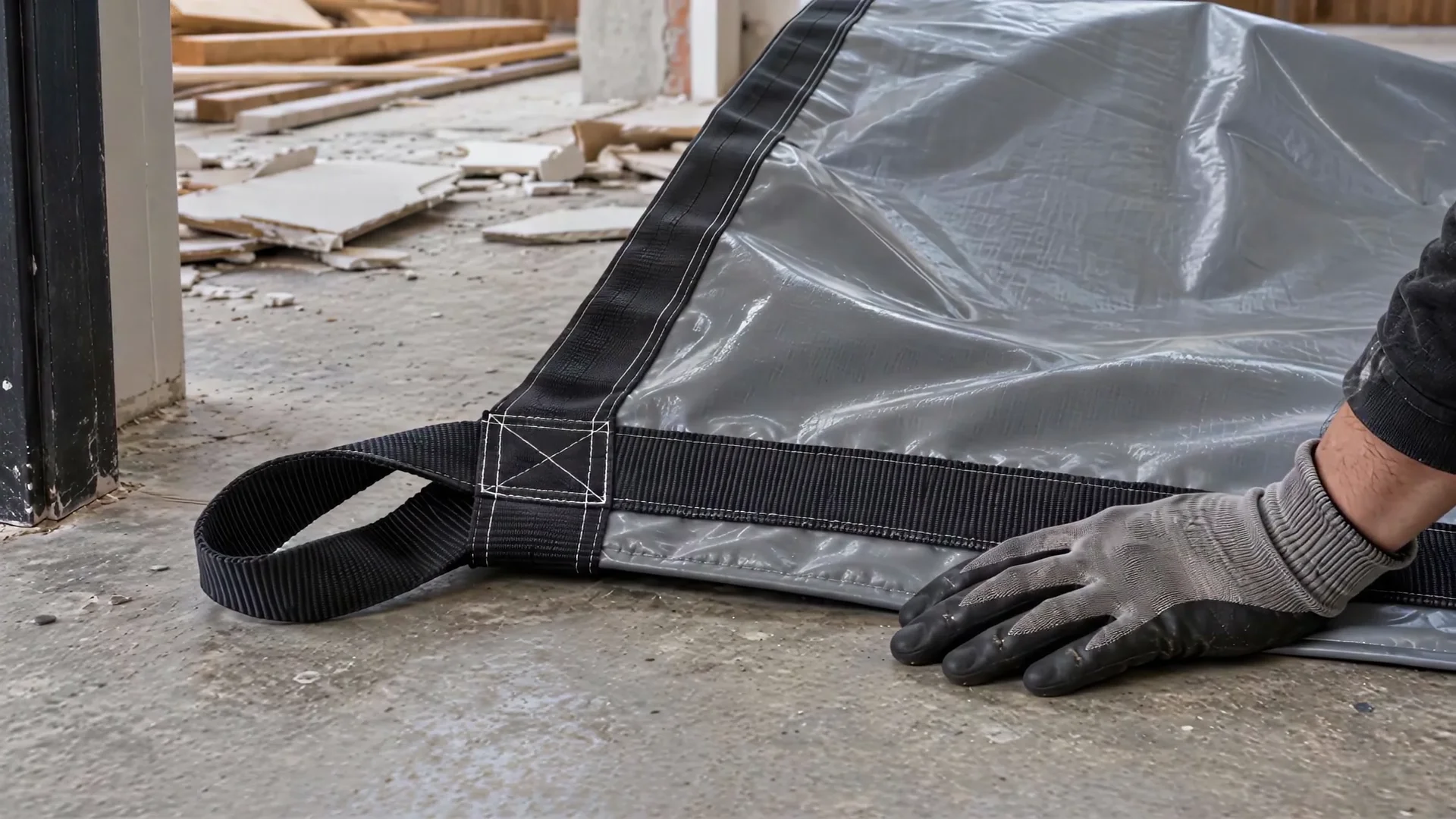
DLT-5153
PVC Coated Polyester for Lifting Tarp Construction
A PVC-coated sheet with woven polyester reinforcement for lifting-tarp fabrication.
- Weight
- 1000gsm / 29.5oz/yd²
- Width
- Custom width to order
Product images
TECHNICAL DATASHEET
| Structure: | PVC coated polyester fabric |
|---|---|
| Base fabric: | 1000D×1000D |
| Fabric density: | 30×30threads/inch |
| Width: | Custom width to order |
| Weight: | 1000gsm / 29.5oz/yd² |
| Colour: | Blue; custom colours available |
| Tensile strength: | Target: 4500/4000N/5cm (warp/weft) |
| Tearing strength: | Target: 650/550N (warp/weft) |
| Peeling off strength: | Target: 140N/5cm |
| Processing: | Hot-air welding, high-frequency welding and sewing |
| Supply format: | Roll material |
| Customize options: | Colour, thickness, width, flame retardancy, environmental compliance, anti-static, anti-mildew and antibacterial formulations |
| Package: | Paper tube + Kraft paper |
| Meter per roll: | Custom roll length to order |
APPLICATIONS:
Product Features
- AntistaticOptionalAvailable as an optional configuration. Helps manage electrostatic charge build-up in the fabric, giving manufacturers a material option for assemblies with specified static-control requirements.
- Flame retardantOptionalAvailable as an optional configuration. A flame-retardant formulation for fabricators supplying projects with defined fire-behaviour requirements. Select the grade around the test method required for the finished application.
- Mildew resistantOptionalAvailable as an optional configuration. A mildew-resistant formulation helps address surface growth in damp or humid service conditions and during storage between uses.
A 30×30 Polyester Reinforcement
DLT-5153 lists a 1000D×1000D base with 30×30threads/inch. This describes the internal fabric before considering the surrounding PVC. The finished sheet weighs 1000gsm, which includes the coating. Comparing that number with the yarn construction helps avoid treating all heavy sheets as equivalent. Fabric direction should be recorded on trial panels so that the assembled design can be assessed against the intended material orientation.
Coating Adhesion and Finished Joins
The PVC-to-polyester bond and the fabricated seam are different parts of DLT-5153 evaluation. Peeling examines adhesion within the coated material; joining trials examine a seam or connection made during fabrication. The record lists hot-air welding, high-frequency welding and sewing, with mechanical values described as targets. Verification of lifting-tarp construction should include the complete connection between fabric panels and lifting components.
Application requirements — Lifting Tarps
Specify the panel length and width, the material being collected, the proposed load and the lifting arrangement. Review fabric tensile and tear properties, coating adhesion and the reinforced connections between the sheet, webbing and lifting points. Working-load capacity must be established for the completed lifting assembly; fabric weight and target fabric strengths alone do not define a rated lifting capacity.
Typical finished lifting-tarp specifications
Published snow-lifting tarp configurations provide the following reference sizes and construction details. These describe finished products; the final specification follows the intended application.
| Specification | Finished-product reference |
|---|---|
| Finished size, laid flat | 6 × 6 m; 20 × 20 ft (6.10 × 6.10 m); 25 × 25 ft (7.62 × 7.62 m); 30 × 30 ft (9.14 × 9.14 m) |
| Lifting points | Four corner lifting loops in the reference configurations |
| Webbing arrangement | Continuous corner-to-corner webbing sewn into the tarp assembly |
| Webbing width | 2 in (51 mm), with 3 in (76 mm) options in published snow-tarp examples |
| Lifting-loop length | 12 in (305 mm) in the reference configuration; confirm the finished loop dimensions for the lifting connection |
| Corner reinforcement | Additional corner reinforcement with sewn carrying straps |
| Typical use | Laid out on construction working surfaces before snowfall, then lifted by the corner loops for snow removal |
| Working-load rating | Confirm the rating for the complete tarp, its lifting arrangement and the intended load with the finished-product manufacturer |
Reference dimensions and component options are for application planning. Confirm the specification and working-load rating for the completed tarp.
How the fabric fits into a lifting tarp
DLT-5153 supplies the coated panel material. The example below separates that panel from the continuous load-bearing webbing, lifting loops and reinforced sewn connections added by the finished-tarp manufacturer.
A · Coated fabric panel. The PVC surface and woven polyester base form the flexible sheet. Panel tensile and tear behaviour are material properties, separate from the completed lifting system.
B · Continuous load-bearing webbing. The example route connects opposing corners through the underside. Webbing capacity and its connection to the sheet are specified by the finished-tarp manufacturer.
C · Loops and reinforced sewn connections. Loads enter the lifting arrangement through these connections. The webbing specification, reinforcement and stitching pattern must be verified together in the assembled tarp.
Example construction principles, not a production drawing. Loop count, webbing route, reinforcement, dimensions and safe working load follow the verified finished-tarp design.
Material Insights 3 videos
Heavier Isn't Always Stronger: Choosing PVC Tarpaulin
Material Guide
Discuss the application.
For PVC coated polyester rolls, send the panel and strap layout with required width, roll length and sample-test requirements.
PVC Coated Polyester: Fabric Density and Composite Weight
DLT-5153 is PVC coated polyester listed at 1000gsm, also expressed as 29.5oz/yd². The reinforcing base uses 1000D×1000D yarns with a density of 30×30threads/inch. PVC covers the textile to form the finished sheet. The material is supplied in rolls for further cutting and assembly, with blue listed as the standard colour and custom colours available.
The equal denier figures indicate the same nominal yarn size in both fabric directions. The density pair describes the number of threads per inch. These construction details help a buyer understand the fabric beneath the PVC, while finished-sheet tests establish mechanical performance. Area weight includes both textile and coating, and therefore cannot be used to calculate the strength of a completed lifting tarp.
Hot-air welding, high-frequency welding and sewing are identified as processing methods. The production record does not specify the equipment used to apply the PVC coating. A joining trial should include the intended material configuration and the actual reinforcement arrangement. Coating adhesion, seam behaviour and the way straps connect to the panel each require their own attention.
Width and roll length are made to order. For lifting-tarp construction, use these dimensions to develop panel nesting and minimise unnecessary joins where the design allows. The listed tensile, tear and peeling values are targets. Confirm their test basis and verification status, then assess the whole assembly before assigning any working-load rating to the finished product.