
DLT-5312
Tunnel Repair Fabric
A PVC composite with a polyester base for tunnel liners and liner repair trials.
- Weight
- 1100g(±10g)/sqm
- Width
- 1.02m-5.0m
Product images
TECHNICAL DATASHEET
| Structure: | PVC film+Polyester base fabric+PVC film |
|---|---|
| Base fabric: | 1300D |
| Width: | 1.02m-5.0m |
| Weight: | 1100g(±10g)/sqm |
| Thickness: | 0.9mm |
| Colour: | Black/Yellow/RAL1018 or customized |
| Flame retardant: | Self-extinguish |
| Tensile strength: | 5270/5110(N/5cm) |
| Tearing strength: | 1000/800(N/5cm) |
| Peeling off strength: | 100(N/5cm) |
| Anti-static: | <200 megohm or 1×10^8Ω |
| Suitable temperature: | -20° to +70° |
| Package: | Paper tube + Craft paper |
| Meter per roll: | 30m-506m |
APPLICATIONS:
Product Features
- AntistaticHelps manage electrostatic charge build-up in the fabric, giving manufacturers a material option for assemblies with specified static-control requirements.
- Flame retardantA flame-retardant formulation for fabricators supplying projects with defined fire-behaviour requirements. Select the grade around the test method required for the finished application.
1300D Base Within a 0.9mm Sheet
The 1300D polyester base specified for DLT-5312 is enclosed by PVC film faces. Its 1100gsm nominal mass and 0.9mm thickness describe the entire composite. When evaluating a patch material, check this construction against the existing liner and its required flexibility. A thicker replacement is not automatically a compatible repair, and the model’s manufacturing route should be confirmed when it affects joining decisions.
The Repair Interface Requires a Trial
A repair adds a joint between DLT-5312 and the existing liner. That joint needs assessment on a representative, properly prepared surface using the intended process. The sheet’s internal peeling property cannot be used as the repair-bond rating. Agree the overlap, retained edges and performance requirements before fabrication. Fire and static requirements should be reviewed for the repaired construction, with the source static limit clarified first.
Application requirements — Tunnel Linings
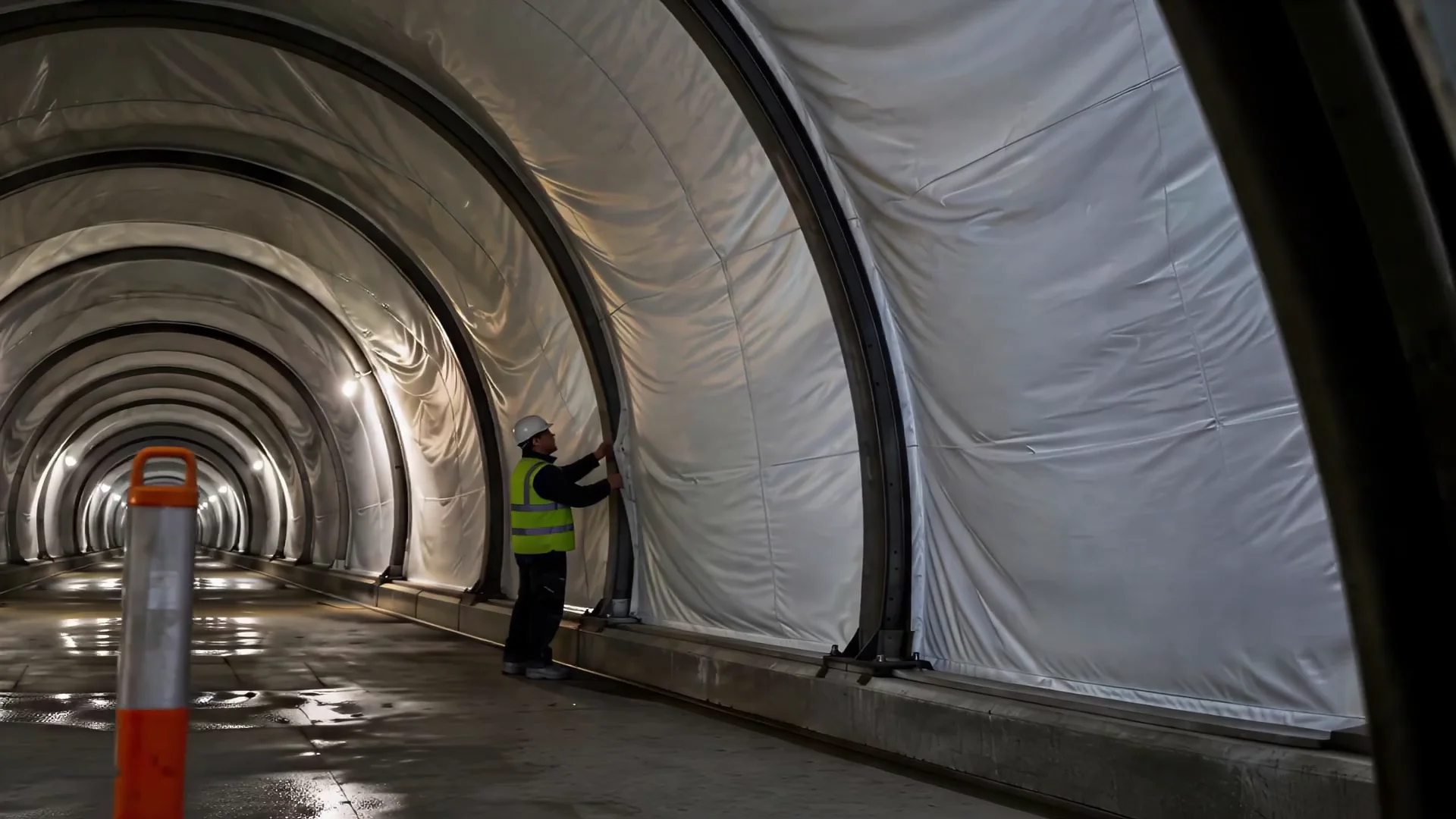
Specify the wall or roof area, panel dimensions, support spacing, edge connections and the intended lining function. Review tensile and tear properties, seam strength and the material response to moisture and repeated handling. State any project-specific fire or static-control requirements. A lining panel and a pressure-carrying ventilation duct perform different jobs and need separate selection criteria.
Finished Fabric-Lining Panel Specifications
Lining panels are made to the underground space and its supporting arrangement. There is no single standard panel size for every tunnel.
| Specification | Configuration |
|---|---|
| Finished Panel Dimensions | Project-specific length and height, taken from the lining cross-section and panel schedule |
| Panel Layout | Wall or roof sections divided around supports, access points and changes in tunnel geometry |
| Panel Connections | Welded overlaps where a continuous PVC facing is required; confirm the overlap and welding procedure on the selected assembly |
| Edge Reinforcement | Reinforced edges specified around hanging points and wall attachments |
| Mounting Details | Define each support and attachment location before cutting the panels |
| Drainage Interfaces | Coordinate drains, penetrations and termination details where the fabric is part of a lining or drainage assembly |
| Installation Format | Pre-cut sections or panels joined on site, selected around available access and handling space |
| Assembly Requirements | Confirm seam integrity, attachment strength and the project's fire and static-control requirements for the completed lining |
Construction Details
Panel Joints And Terminations
A lining layout needs continuous details at overlaps, edges and penetrations. Mark these on the drawing before setting the panel cutting dimensions.
Support And Drainage Layers
Specify the role of the fabric within the assembly, including any backing or drainage layer. The material data sheet alone does not establish permanent tunnel waterproofing performance.
Product Videos 1 video
Antistatic Tarpaulin: Material Demonstration
Production & Material Footage
Discuss the application.
For tunnel repair fabric rolls, identify the existing liner, its condition and the proposed repair method.
Tunnel Repair Fabric: Matching the Composite and the Joint
DLT-5312 is listed at 1100gsm with a ±10gsm tolerance and 0.9mm thickness. Its stated layers are PVC film, a 1300D polyester base and PVC film. The reinforcement is therefore part of a substantial composite sheet. The denier entry describes the base yarn, while mass and thickness describe the finished material selected for fabrication.
For a proposed liner patch, material identity matters at both sides of the new joint. The replacement sheet’s film-to-textile bond is one property; its compatibility with the existing liner surface is another. The source’s peeling value concerns the former. It does not establish the strength of a repair made to an aged or differently finished material. The precise sheet manufacturing route is not provided.
DLT-5312 is listed in widths from 1.02m to 5.0m, with black and yellow RAL 1018 and custom colour options. The source describes self-extinguishing and antistatic characteristics, which require defined evidence where applicable. Its static-resistance expressions should be clarified before a numerical limit is adopted. A repair also needs to preserve any performance required of the original installation, rather than relying on a new sheet’s description alone.
Before specifying a tunnel liner patch, identify the existing material, its condition and the intended repair function. Trial the proposed seam or bond on a representative section with the actual preparation and joining method. Determine patch overlap and edge details from the repair design. Sheet weight alone cannot establish repair compatibility, water tightness or the load capacity of the completed connection.