
DLT-5103
Bounce House Vinyl for Obstacle Course Panels
A PVC film laminate with woven polyester reinforcement for inflatable play equipment.
- Weight
- 610gsm
- Width
- 1.05-3.2m
Product images
TECHNICAL DATASHEET
| Technology: | Lamination / Coating |
|---|---|
| Structure: | PVC film+Woven polyester base fabric+PVC film / 3 layers laminated |
| Surface: | Glossy/Matte |
| Thickness: | 0.5mm |
| Weight: | 610gsm |
| Width: | 1.05-3.2m |
| Roll length: | 50m |
| Packing: | Paper tube+PE film+Craft paper |
| MOQ: | 1000yards for customization/ 100yards for in-stock |
APPLICATIONS:
Product Features
- Flame retardantOptionalAvailable as an optional configuration. A flame-retardant formulation for fabricators supplying projects with defined fire-behaviour requirements. Select the grade around the test method required for the finished application.
Polyester Reinforcement Inside the Vinyl
The word vinyl describes the PVC surface of DLT-5103, while its construction includes woven polyester underneath. Reinforcement direction remains relevant even when the weave is not visible through the face. The listed 610gsm covers all three layers. Buyers comparing this grade should check the material build and bond as well as mass, since an increase in PVC alone does not establish a corresponding increase in textile strength.
Bonded Layers and Repeated Folding
A laminated sheet depends on adhesion between its PVC films and fabric. In a fabricated inflatable, folding brings those interfaces through repeated changes in curvature. DLT-5103 samples can be reviewed for surface continuity, fold behaviour and joining consistency using the selected finish. The product lists glossy and matte versions; a trial from the intended production version gives a more useful reference than a sample with a different surface.
Application requirements — Inflatable Play Equipment
Specify the structure dimensions, panel function, operating pressure, seam design and anchoring arrangement. Review tensile and tear properties, flexing and the integrity of welded or sewn connections. Confirm whether the construction needs an airtight skin or continuous airflow. Assess leakage, loading and any destination-market requirements on the finished inflatable structure.
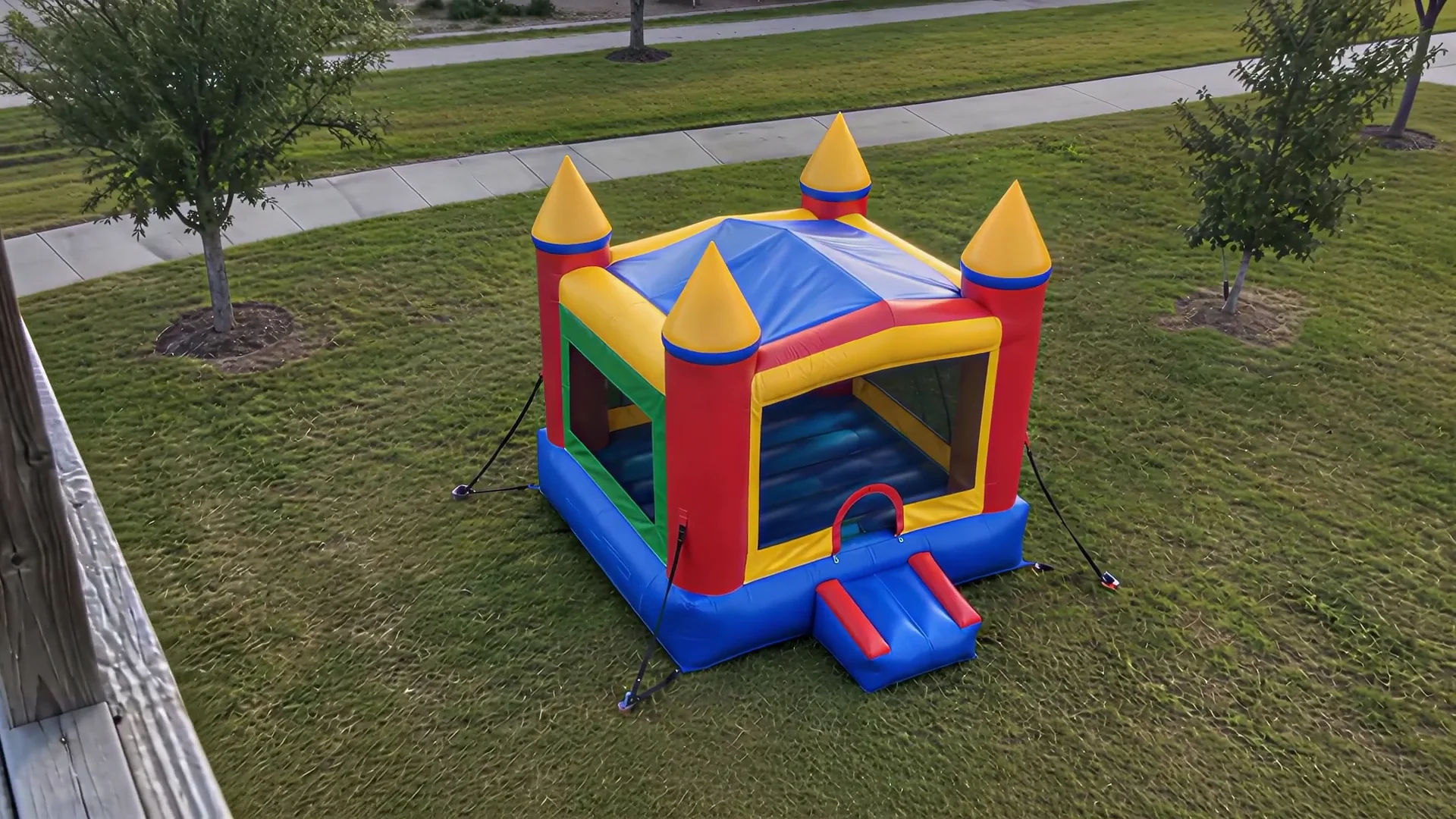
Finished Bounce-House Configurations
These configurations describe continuous-air bounce houses. Airtight inflatables need a different seam and pressure design.
| Specification | Configuration |
|---|---|
| Square Footprints | 13 × 13 ft or 15 × 15 ft (approximately 3.96 × 3.96 m or 4.57 × 4.57 m) |
| Overall Height Example | 13 ft (approximately 3.96 m) for the square configurations |
| Air Supply | Continuous blower operation; match the blower and intake arrangement to the complete unit |
| Panel Assembly | Sewn body panels, with double or quadruple stitching used in commercial constructions |
| Wear Areas | Additional reinforcement around the jumping surface, entrances and other high-traffic areas |
| Anchoring Connections | Tie-down straps attached through reinforced fabric areas; layout and restraint loads follow the finished-unit design |
| Enclosure And Access | Mesh viewing panels, a defined entrance and accessible inflation/deflation openings |
| Finished-Unit Selection | Confirm usable play area, user limits, installation clearance and operating instructions with the unit manufacturer |
Construction Details
Reinforced Strap Attachment
An extra layer of PVC fabric spreads the attachment over a larger area. Review the strap, stitching and reinforcing patch together when sampling the assembly.
Air Intake And Deflation
Intake sleeves connect the blower to the inflated body. The finished layout needs access to its closure flaps and deflation openings for packing and inspection.
Material Insights 3 videos
Heavier Isn't Always Stronger: Choosing PVC Tarpaulin
Material Guide
Discuss the application.
When requesting bounce house vinyl rolls for a proposed obstacle course, provide panel shapes, colour choices and the planned joining method.
Bounce House Vinyl: Understanding the Composite
DLT-5103 is a 610gsm bounce house vinyl with a 0.5mm nominal thickness. A woven polyester base sits between two PVC films in the listed three-layer laminate. The textile reinforcement runs through the sheet and influences how a cut panel responds to tension. The PVC faces cover that core and provide the outer surface visible on the finished inflatable.
The technology is recorded as lamination/coating. This description supports discussing a bonded film-and-fabric composite, without identifying a particular coating machine or production setting. Film adhesion and continuity are useful material checks because repeated bending and joining involve the complete layered sheet. Material inspection should consider both faces and a cut edge, where the relationship between film and core can be seen.
Glossy and matte options allow the surface to be agreed with the colour scheme. For a proposed obstacle course, compare the finish on the actual panel colours and examine areas that will fold during packing. An approved material sample should remain the reference for both appearance and subsequent fabrication trials. A change of finish should be reviewed before continuing with the same joining settings.
The material is listed in 50m rolls and widths of 1.05m to 3.2m. The cutting layout can use those dimensions to place large panels and reinforcement pieces. The proposed obstacle shapes, seams and inflation arrangement still require evaluation by the finished-unit manufacturer; the roll specification supplies the material starting point.