
DLT-7009
Double Polished Clear Vinyl for Boat Window Replacement
A clear PVC film listed with a water-quench process for flexible tent and marine windows.
- Max width
- 2.8meters
- Thickness
- 0.9mm
Product images
TECHNICAL DATASHEET
| Technology: | Calendering+Lamination |
|---|---|
| Feature: | Water quench |
| Hardness: | 20-60 PHR According to customer’s requirements |
| UV resistetant | 3.5 ASTM G154-06 Standard |
| Transparency: | Super clear |
| Thickness: | 0.9mm |
| Max width: | 2.8meters |
| Vicat softening point: | 75°C |
| Packing: | PE foam or kraft paper with clear film or color film; |
| Certification: | Reach/RoHS; Anti UV; Anti Cold; Anti Static; Fire Retardent |
| ITEM | PHR | 30PHR↓ | 31~40 | 41~50 | 51~60 | Test method |
|---|---|---|---|---|---|---|
| Tensile strength (kg/cm²) | MD | ≧250 | ≧230 | ≧210 | ≧180 | ASTM D-882 |
| CD | ≧230 | ≧210 | ≧190 | ≧170 | ||
| Elongation (%) | MD | ≧170 | ≧200 | ≧220 | ≧260 | ASTM D-882 |
| CD | ≧180 | ≧220 | ≧240 | ≧280 | ||
| Tear strength (kg/mm) | MD | ≧9 | ≧7 | ≧6 | ≧5 | ASTM D-882 |
| CD | ≧9 | ≧7 | ≧6 | ≧5 | ||
| ITEM | Thickness (mm) / PHR | 30PHR↓ | 31~40 | 41~50 | 51~60 | Test method |
| Dimensional stability (-%) | 0.09m/m↓ | ≦5 | ≦7 | ≦9 | ≦9 | ASTM D-882 |
| 0.091-0.152 | ≦4 | ≦6 | ≦7 | ≦8 | ||
| 0.153-0.254 | ≦3 | ≦5 | ≦6 | ≦7 | ||
| 0.255-0.50 | ≦3 | ≦4 | ≦4 | ≦5 |
Scroll horizontally to view all columns.
APPLICATIONS:
Product Features
- AntistaticHelps manage electrostatic charge build-up in the fabric, giving manufacturers a material option for assemblies with specified static-control requirements.
- Flame retardantA flame-retardant formulation for fabricators supplying projects with defined fire-behaviour requirements. Select the grade around the test method required for the finished application.
- UV resistantUV-resistant treatment addresses sunlight exposure in outdoor fabric panels, making weathering requirements part of the material choice from the start.
A 0.9mm Transparent Film
DLT-7009 is specified as a clear PVC film with an overall 0.9mm gauge. No textile reinforcement is listed, and the individual layers used in lamination are not described. The selected material should be checked against the window pattern and desired flexibility. A replacement sample that includes the edge construction is more useful than matching thickness alone, particularly where the panel will be rolled or folded.
Surface Appearance And Process Evidence
Calendering, lamination and water quench are the stated production terms for DLT-7009. A double-polished finish should be agreed against an actual surface sample during procurement. Compare the sample for the required view and reflections, and confirm the finish in the order. Keep an unworked reference alongside the fabricated window so original film appearance can be distinguished from changes introduced by joining or tension.
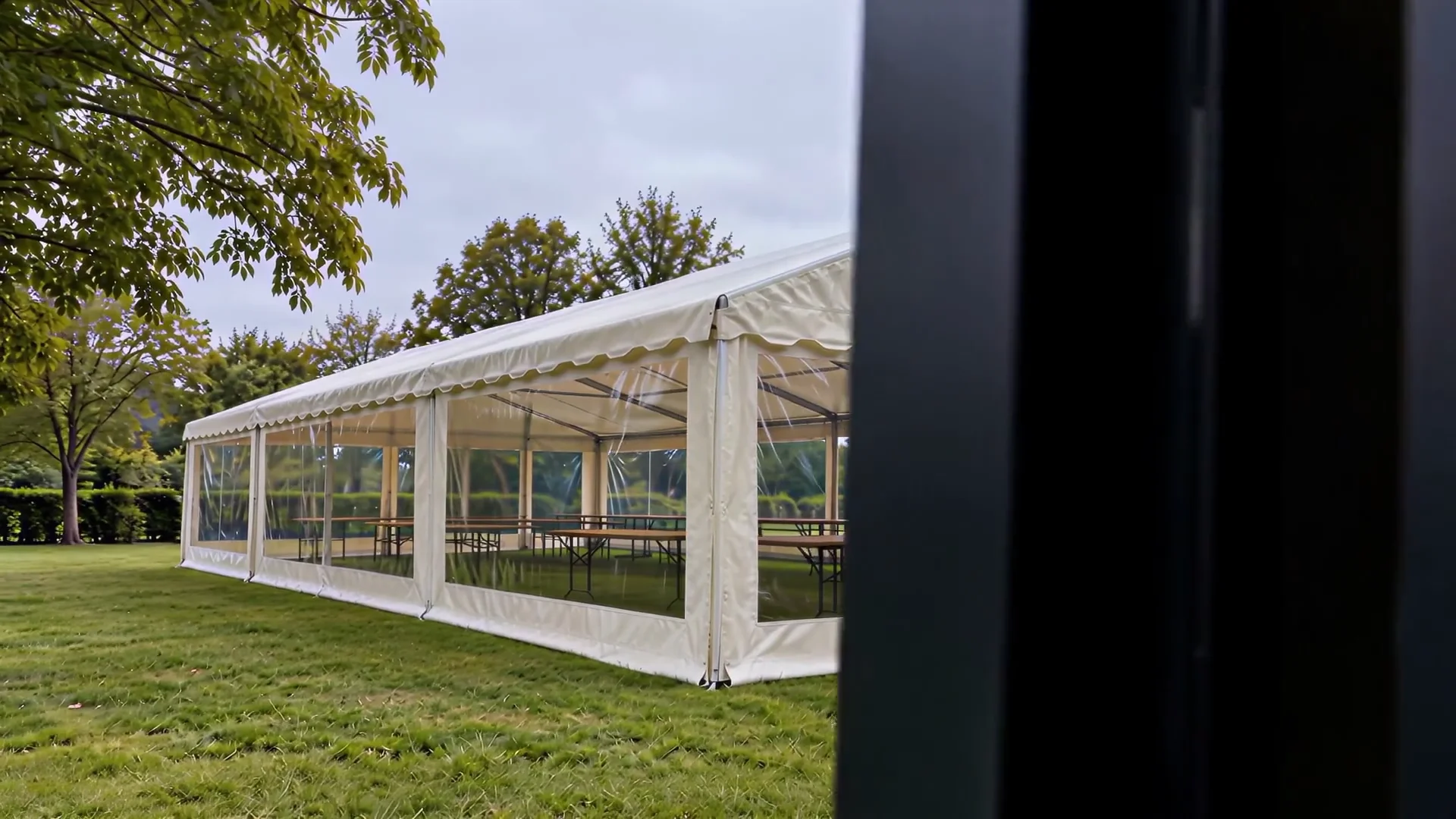
Application requirements — Clear Tent Windows
Specify window or panel dimensions, thickness, viewing requirements, framing and the normal folding or rolling pattern. Review optical appearance, flexibility, surface marking and the edge or seam construction. Confirm the temperature range, cleaning method and any specified fire behaviour on the selected grade.
Finished Clear-Panel Specifications
Measure clear enclosure panels on the supporting frame. The panel outline, fixing edges and opening arrangement determine the cutting pattern.
| Specification | Configuration |
|---|---|
| Panel Dimensions | Measured clear opening plus the specified border and attachment allowance |
| Panel Layout | Fixed window, removable panel or a zippered roll-up section |
| Border | Fabric facing around the clear panel; binding covers exposed edges |
| Upper Attachment | Zipper connection to a fabric top, where the enclosure design uses one |
| Side Opening | Straight or curved zipper fitted to the planned opening |
| Lower Attachment | Snaps located to match the supporting structure |
| Roll-Up Retention | Webbing straps positioned to hold the opened window |
| Pattern Approval | Check fit, access, sightlines and zipper travel on the frame |
Construction Details
Border And Attachment
The facing carries the zipper or fasteners around the transparent area. Match its outline to the frame before cutting the clear panel.
Roll-Up Section
A zippered opening can roll up and be secured with straps. Protect zipper edges with flaps where the chosen design requires them.
Product Videos 3 videos
Clear PVC Film: Production and Inspection
Production & Material Footage
Discuss the application.
For double polished clear vinyl rolls, confirm the required finish sample, window pattern and fabrication method.
Clear Vinyl For Window Replacement Panels
DLT-7009 is a clear PVC film at a listed 0.9mm thickness, made using calendering and lamination with water quench. The material data identify a film product, without a woven reinforcing core. Its overall gauge and clear appearance are relevant when replacing a flexible window, but the existing window pattern and edge assembly also need to be reviewed before selecting the supplied configuration.
The calendering process forms PVC compound into sheet between rolls. Lamination combines formed layers, although the product data do not state a layer count. The listed super-clear appearance should be checked on a physical sample. If a project specifies double polished clear vinyl, agree that required surface condition explicitly with the sample and order; the available process description alone does not document a separate double-polishing operation.
Maximum listed width is 2.8m, and the formulation range is 20-60PHR. This ratio describes plasticizer content relative to resin. Thickness, formulation and surface appearance together affect the material selected for a replacement window. Match the proposed film to the required flexibility and storage arrangement, then inspect it under representative light at the intended panel size rather than judging a small sample alone.
Boat window replacement also requires a trial with the actual binding, surrounding fabric and closure. Check the clear area after joining and examine the panel in its installed shape. Agree exposure and cleaning requirements for the supplied film. A nominal thickness or an application name does not replace the evidence needed for a specific marine service requirement.