
DLT-5902
Flexible Tank Fabric
A PVC and polyester composite with alternative woven bases for flexible tank panels and containment berms.
- Weight
- 1450gsm
- Width
- 1-3.2Meters
Product images
TECHNICAL DATASHEET
| Material: | PVC+Polyester |
|---|---|
| Base fabric: | 1000x1000D/30*30 or 1300D/15*15 |
| Thickness: | 2.0mm |
| Weight: | 1450gsm |
| Tensile strength: | Warp 6000N/5cm Weft 5500N/5cm |
| Peeling strength: | 120N/5cm |
| Width: | 1-3.2Meters |
| Options: | Flame retardent, Self cleaning surface |
APPLICATIONS:
Product Features
- Flame retardantOptionalAvailable as an optional configuration. A flame-retardant formulation for fabricators supplying projects with defined fire-behaviour requirements. Select the grade around the test method required for the finished application.
- Self-cleaning surfaceOptionalAvailable as an optional configuration. The surface finish helps dirt release from the coated face, supporting the appearance and routine care of exposed fabric panels.
Two Base Constructions to Specify
DLT-5902 lists 1000D, 30 × 30 and 1300D, 15 × 15 as alternatives. The larger yarn designation does not make the two constructions interchangeable without review, because yarn count changes at the same time. Ask for the selected reinforcement to be recorded with the sample. This keeps comparisons tied to a defined construction rather than treating the model name as a complete description of every available configuration.
Thickness and Joint Development
The listed 2.0mm thickness describes DLT-5902 as a complete sheet. An overlap creates a thicker local assembly, and the valve area may include further reinforcement pieces. Those details should be trialled using the intended conversion process. The sheet’s tensile and adhesion values give useful material information, while a representative welded or joined section supplies different evidence about the proposed tank construction and its workmanship.
Application requirements — Flexible Water Tanks
Specify vessel or liner dimensions, liquid type, fill depth, support arrangement and the cleaning method. Review liquid compatibility, coating adhesion, seam integrity and the response to flexing and temperature. Distinguish a supported liner from a self-supporting finished vessel. Drinking-water, food-contact or other regulated uses need evidence for the exact proposed formulation and assembly.
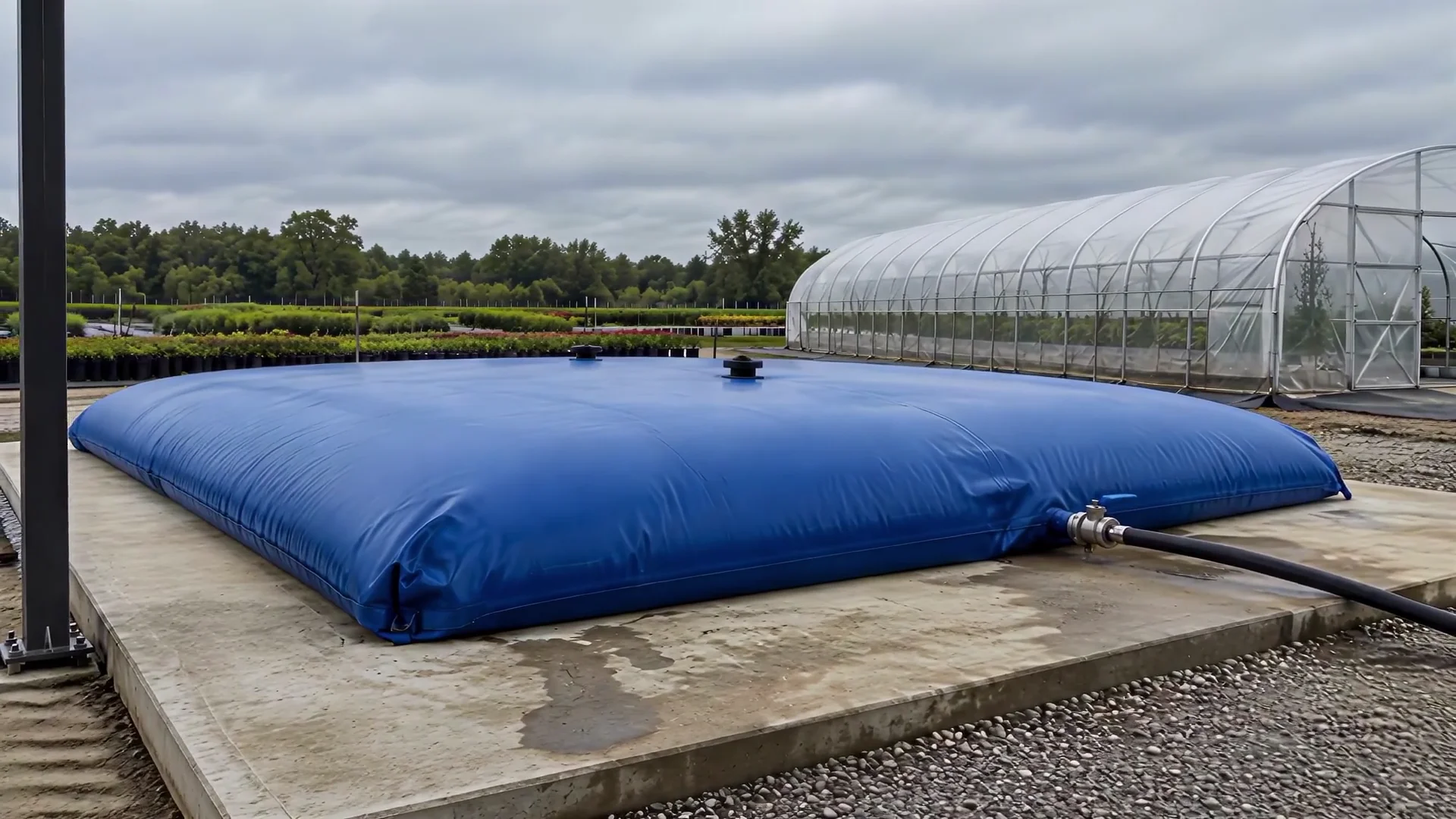
Finished Pillow-Tank Configurations
Capacity, plan size and filled height must be specified together. The examples below describe complete welded tanks, not a capacity rating for the fabric.
| Specification | Configuration |
|---|---|
| 30 m³ Configuration Example | 8.20 × 4.44 m plan dimensions; 1.30 m stated height |
| 60 m³ Configuration Example | 10.00 × 5.92 m plan dimensions; 1.50 m stated height |
| 100 m³ Configuration Example | 12.10 × 7.40 m plan dimensions; 1.60 m stated height |
| Body Construction | Closed flexible shell assembled with high-frequency welded seams |
| Fittings | Valve, overflow and inspection hatch selected for the tank layout |
| Supporting Platform | Flat, clean and stable, with adequate bearing capacity and drainage |
| Service Clearance | Allow access around the tank for fittings and inspection |
| Stored Liquid | Confirm formulation compatibility and any required contact approval for the intended liquid |
Construction Details
Welded Shell And Fittings
Show seams and fitting positions on the tank drawing. Review the assembled joint around each connection.
Footprint And Filled Height
Agree the dimension convention and operating fill height with the tank designer before cutting panels.
Material Insights 3 videos
Heavier Isn't Always Stronger: Choosing PVC Tarpaulin
Material Guide
Discuss the application.
For flexible tank fabric, specify the reinforcement option, stored liquid and tank joint layout for review.
Understanding the Reinforcement Options in Flexible Tank Fabric
DLT-5902 is a PVC and polyester flexible tank fabric listed at 1450gsm and 2.0mm thick. The product sheet offers two base descriptions: 1000D at 30 × 30 or 1300D at 15 × 15. These are alternative reinforcement configurations, not two fabrics automatically contained in the same sheet. Yarn size and yarn count describe different aspects of a weave, so the selected base should be identified when requesting a sample or agreeing a production order.
The polymer and textile work together as a composite. Polyester provides the woven reinforcement, while the PVC component provides the material surfaces used during conversion. The current record does not identify the coating or lamination process, and it does not state a separate thickness for each component. The 2.0mm figure therefore belongs to the complete listed material. Joining several panels adds further local thickness and needs to be assessed with the intended fabrication equipment.
The stated tensile values are 6000/5500N per 5cm, with peel adhesion of 120N per 5cm. A higher tensile figure does not by itself specify a finished tank volume, working pressure or joint design. Widths range from 1–3.2m. In water tank panels, the material selection should be connected to panel dimensions, corner construction and valve reinforcement. Include the proposed seam in sample review and confirm the liquid to be stored. Any requirement for drinking-water contact needs specific supporting documentation rather than being inferred from the water tank application name.