
DLT-5904
Water Tank Material
A flexible tank panel material with a polyester reinforcing base.
- Weight
- 2700gsm
- Width
- 1-3.2Meters
Product images
TECHNICAL DATASHEET
| Material: | 100% Polyester |
|---|---|
| Base fabric: | 1300x1300D/30*32 |
| Weight: | 2700gsm |
| Thickness: | 1.5mm |
| Width: | 1-3.2Meters |
| Options: | Flame retardent, Self cleaning surface |
APPLICATIONS:
Product Features
- Flame retardantOptionalAvailable as an optional configuration. A flame-retardant formulation for fabricators supplying projects with defined fire-behaviour requirements. Select the grade around the test method required for the finished application.
- Self-cleaning surfaceOptionalAvailable as an optional configuration. The surface finish helps dirt release from the coated face, supporting the appearance and routine care of exposed fabric panels.
Mass Is Only One Part of the Sheet
DLT-5904 is listed at 2700gsm, but this value does not divide the material into textile and surface components. Its 1.5mm thickness and 1300D, 30 × 32 base add other information. Review those measurements together on a defined sample. The current data does not justify a comparison of pressure capacity or service life with another model merely from the difference in listed mass.
Confirming Conversion Details
Before using DLT-5904 in flexible tank panels, establish the material surfaces and the joining method they support. The base fabric description alone cannot provide welding settings or a finished joint rating. A useful trial includes an overlap and a reinforced fitting location. Review that assembly with the proposed tank layout and stored medium so the selected material and the finished construction are specified together.
Application requirements — Flexible Water Tanks
Specify vessel or liner dimensions, liquid type, fill depth, support arrangement and the cleaning method. Review liquid compatibility, coating adhesion, seam integrity and the response to flexing and temperature. Distinguish a supported liner from a self-supporting finished vessel. Drinking-water, food-contact or other regulated uses need evidence for the exact proposed formulation and assembly.
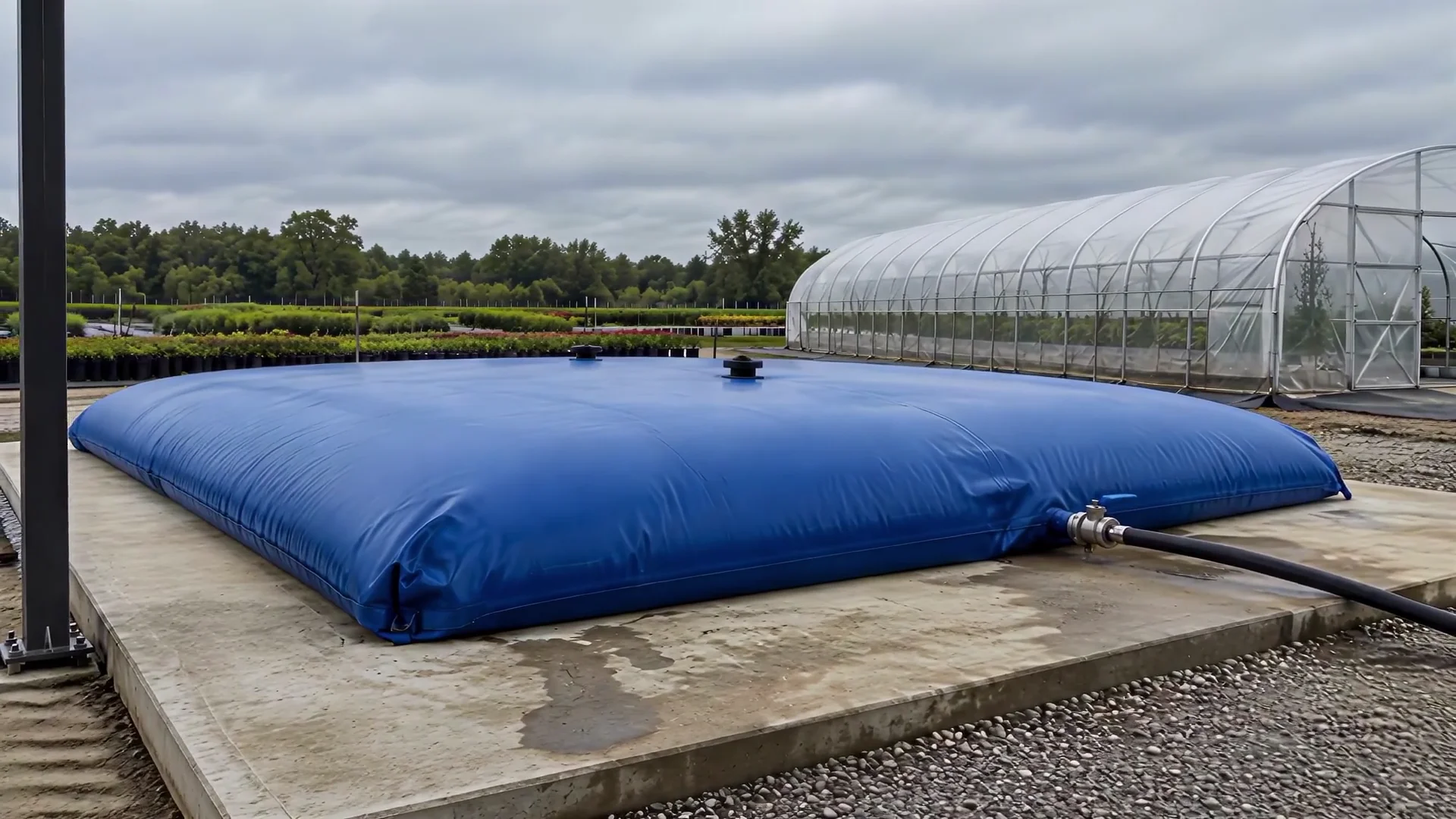
Finished Pillow-Tank Configurations
Capacity, plan size and filled height must be specified together. The examples below describe complete welded tanks, not a capacity rating for the fabric.
| Specification | Configuration |
|---|---|
| 30 m³ Configuration Example | 8.20 × 4.44 m plan dimensions; 1.30 m stated height |
| 60 m³ Configuration Example | 10.00 × 5.92 m plan dimensions; 1.50 m stated height |
| 100 m³ Configuration Example | 12.10 × 7.40 m plan dimensions; 1.60 m stated height |
| Body Construction | Closed flexible shell assembled with high-frequency welded seams |
| Fittings | Valve, overflow and inspection hatch selected for the tank layout |
| Supporting Platform | Flat, clean and stable, with adequate bearing capacity and drainage |
| Service Clearance | Allow access around the tank for fittings and inspection |
| Stored Liquid | Confirm formulation compatibility and any required contact approval for the intended liquid |
Construction Details
Welded Shell And Fittings
Show seams and fitting positions on the tank drawing. Review the assembled joint around each connection.
Footprint And Filled Height
Agree the dimension convention and operating fill height with the tank designer before cutting panels.
Material Insights 3 videos
Heavier Isn't Always Stronger: Choosing PVC Tarpaulin
Material Guide
Discuss the application.
For water tank material, provide the storage medium and panel design while confirming the surface and joint construction.
Water Tank Material: Base Fabric, Mass and Assembly
DLT-5904 has a listed polyester reinforcement of 1300D yarn with a 30 × 32 construction. Its recorded material weight is 2700gsm and its thickness is 1.5mm. These figures describe different aspects of the sheet: mass measures material per unit area, thickness measures its overall section, and the yarn information describes the textile base. They should be kept together when reviewing a roll sample rather than used as interchangeable measures of strength.
The current product record identifies polyester but does not define the complete surface composition or a named production process. Confirm the coating composition and manufacturing route with the supplied sample before choosing a joining method. The supplied sample should establish the exposed surfaces, reinforcement arrangement and suitable conversion method. These details determine how a converter can join panels and incorporate fittings into a flexible storage tank.
Widths are listed from 1–3.2m. The panel layout can use that range to examine material yield and the number of joins, while corner and valve details need separate attention. A substantial sheet still relies on an appropriate joint and support arrangement in the completed container. For flexible storage tanks, specify the stored medium, installation surface and intended handling conditions. Then review a representative assembled section using the confirmed material construction. The final order should identify the selected roll configuration and documented assembly requirements, rather than treating weight alone as a complete tank specification.