
DLT-5901
Water Bladder Fabric
A polyester-reinforced PVC sheet for fabricating flexible water bladders and tank liners.
- Weight
- 1000gsm
- Width
- 1-3.2Meters
Product images
TECHNICAL DATASHEET
| Material: | PVC+Polyester |
|---|---|
| Base fabric: | 1000x1000D/30*30 |
| Thickness: | 0.8mm |
| Weight: | 1000gsm |
| Thickness: | 1.5mm |
| Tensile strength: | Warp 4000N/5cm Weft 3800N/5cm |
| Peeling strength: | 120N/5cm |
| Width: | 1-3.2Meters |
| Options: | Flame retardent, Self cleaning surface |
APPLICATIONS:
Product Features
- Flame retardantOptionalAvailable as an optional configuration. A flame-retardant formulation for fabricators supplying projects with defined fire-behaviour requirements. Select the grade around the test method required for the finished application.
- Self-cleaning surfaceOptionalAvailable as an optional configuration. The surface finish helps dirt release from the coated face, supporting the appearance and routine care of exposed fabric panels.
Fabric Directions and Bladder Panels
The 30 × 30 construction describes the woven reinforcement, while the two tensile values describe strength along its warp and weft directions. DLT-5901 is therefore more usefully assessed with a panel drawing than by weight alone. Keep fabric direction visible in the cutting plan and discuss how joints and fittings transfer force through the sheet. The complete bladder geometry remains part of the converter’s design.
From Reinforced Sheet to Container
A flexible bladder includes joined panels and installed fittings as well as the main roll material. The listed 120N per 5cm peel value concerns layer adhesion within DLT-5901; it is not a pressure rating for a finished tank. Review a sample of the proposed seam and valve area. Confirm the liquid and service conditions separately, including any specific requirements for contact with drinking water.
Application requirements — Flexible Water Tanks
Specify vessel or liner dimensions, liquid type, fill depth, support arrangement and the cleaning method. Review liquid compatibility, coating adhesion, seam integrity and the response to flexing and temperature. Distinguish a supported liner from a self-supporting finished vessel. Drinking-water, food-contact or other regulated uses need evidence for the exact proposed formulation and assembly.
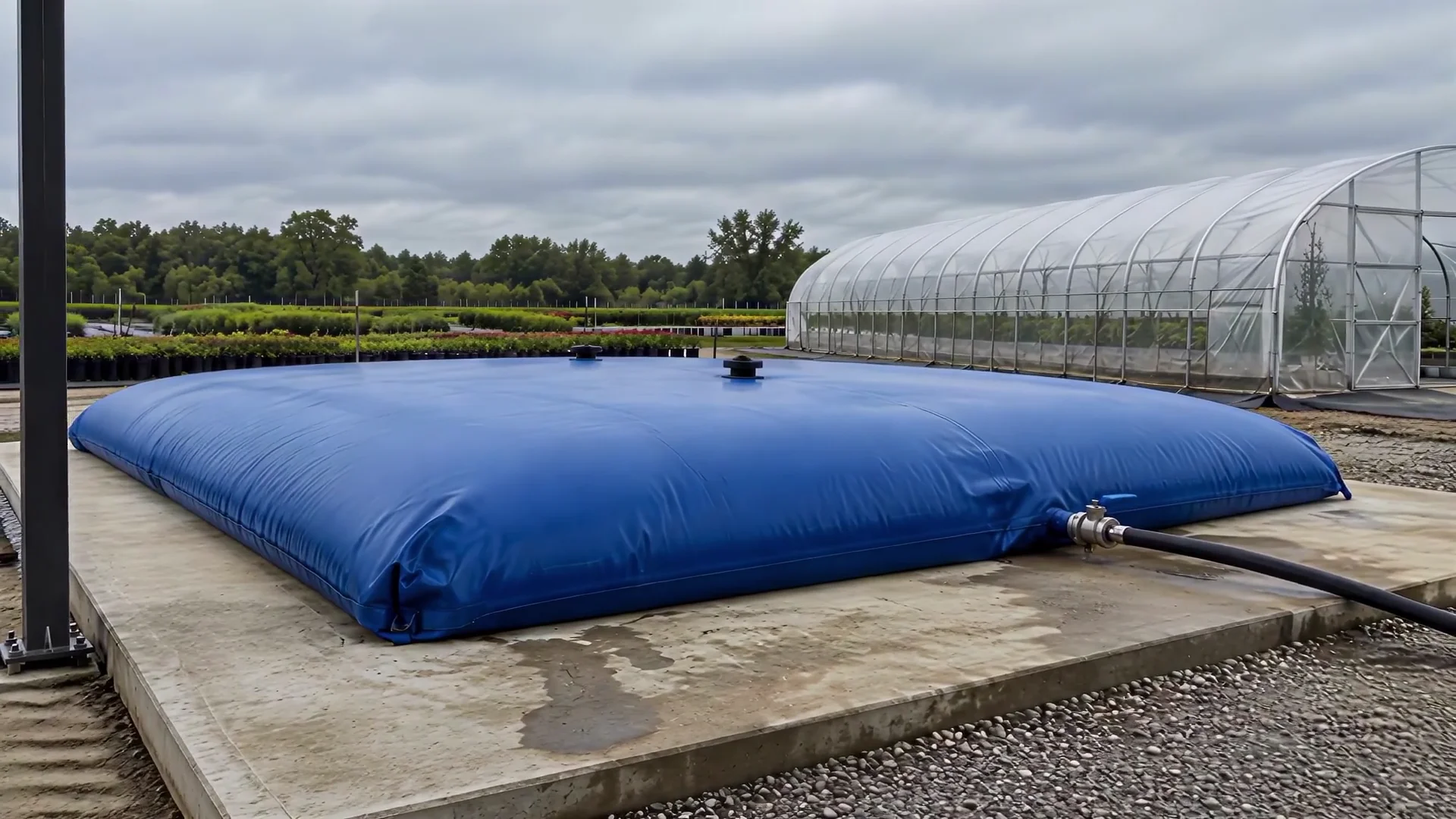
Finished Pillow-Tank Configurations
Capacity, plan size and filled height must be specified together. The examples below describe complete welded tanks, not a capacity rating for the fabric.
| Specification | Configuration |
|---|---|
| 30 m³ Configuration Example | 8.20 × 4.44 m plan dimensions; 1.30 m stated height |
| 60 m³ Configuration Example | 10.00 × 5.92 m plan dimensions; 1.50 m stated height |
| 100 m³ Configuration Example | 12.10 × 7.40 m plan dimensions; 1.60 m stated height |
| Body Construction | Closed flexible shell assembled with high-frequency welded seams |
| Fittings | Valve, overflow and inspection hatch selected for the tank layout |
| Supporting Platform | Flat, clean and stable, with adequate bearing capacity and drainage |
| Service Clearance | Allow access around the tank for fittings and inspection |
| Stored Liquid | Confirm formulation compatibility and any required contact approval for the intended liquid |
Construction Details
Welded Shell And Fittings
Show seams and fitting positions on the tank drawing. Review the assembled joint around each connection.
Footprint And Filled Height
Agree the dimension convention and operating fill height with the tank designer before cutting panels.
Material Insights 3 videos
Heavier Isn't Always Stronger: Choosing PVC Tarpaulin
Material Guide
Discuss the application.
For water bladder fabric, provide the stored liquid, tank drawing and proposed seam and fitting details.
Polyester Reinforcement Inside Water Bladder Fabric
DLT-5901 is listed as PVC and polyester water bladder fabric at 1000gsm and 0.8mm thick. Its woven base uses 1000D × 1000D yarn with a 30 × 30 construction. The polyester network reinforces the flexible sheet, while PVC forms the polymer component of the material. These components serve different purposes: the textile carries forces through the panel and the polymer provides the surfaces that are converted into the bladder envelope.
The specification does not name the production route or divide the listed thickness between individual layers. A finished bladder is made through a separate conversion stage, where flat panels are joined and valves or fittings are installed. The sheet properties and the assembly details both matter. Seam position, corner shape and fitting reinforcement determine how the material is used in the finished container, so a roll sample should be reviewed together with a proposed joint detail.
The product record gives tensile values of 4000N per 5cm in the warp and 3800N per 5cm in the weft, plus peel adhesion of 120N per 5cm. These describe the sheet and its layer bond; they do not establish a complete tank capacity or pressure rating. Widths are listed from 1–3.2m. For flexible water bladders, agree the stored liquid, exposure conditions and conversion process before selecting the roll configuration. If water is intended for drinking, the relevant material and finished-assembly requirements need their own documented confirmation.