
Heat-Welded vs. Sewn Vinyl Tarp Seams: What to Test Before Production
See how the two seams are built and what to check on a production sample.
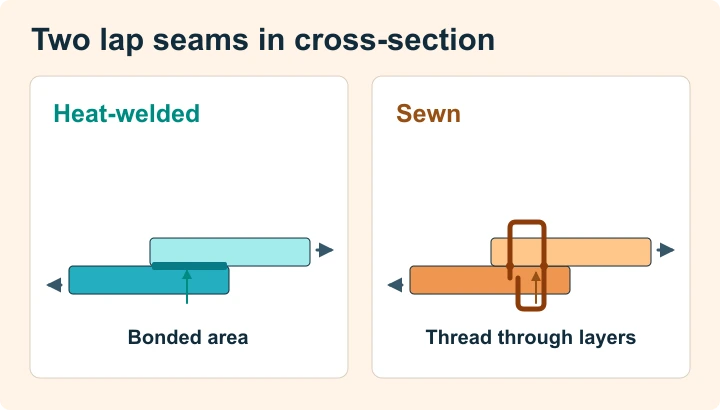
A heat-welded lap seam joins compatible surfaces across an overlap. A sewn seam uses thread to hold the layers together and leaves needle holes along the stitch line. Make a trial seam with the quoted material and production equipment before choosing either method. A sample from the actual assembly tells you how the joint behaves when it is pulled, folded or exposed to water.
Match the seam to the job
| Check | Heat-welded lap seam | Sewn seam |
|---|---|---|
| What forms the joint | A bonded area within the overlap. | Thread passes through the layers at the stitch line. |
| What to examine on a trial piece | Look for skipped bonding, lifting edges, or damage to the coating beside the weld. | Look for skipped stitches, uneven tension or damage around the needle holes. |
| Where water may enter | Inspect gaps in the bond and transitions where seams meet. | Inspect the stitch line and trial any planned seam-sealing detail. |
| What to duplicate in the sample | The proposed joining faces, overlap, equipment and reinforcement. | The proposed fabric layers, thread, stitch pattern and reinforcement. |
Some assemblies use both methods. A cover can have welded panel joins and sewn details at the edge. If the two methods meet at a corner, reproduce that junction in the trial. A sample with straight seams alone leaves that part of the assembly unevaluated.
Make both trial seams under production conditions
Cut the trial pieces from the same proposed grade and record which face and fabric direction each piece uses. Mark the overlap and record the setup used by the operator. Use the machine and reinforcements planned for production. When welding, confirm that the two surfaces to be joined are compatible, including any surface finish. When sewing, write down the thread and stitch setup so the approved result can be repeated.
Keep at least one approved trial piece with the quote or work order. Give the sample an identifier and note the material grade and setup on the record. If a face finish, grade or assembly changes, review whether it needs another trial before using the earlier approval.
Check the finished seam against the buyer's requirements
Inspect both faces and bend the coupon the way the finished tarp will fold or roll. Look for separation at the edge of a weld and damage or movement around the stitch line. If the joint must resist water, agree on the exposure to test and check the seam and any corners or attachments that affect it.
For a strength requirement, agree on the specimen geometry, the direction of pull, the test method and the acceptance limit. Record where failure starts. A failed stitch line, a peeled overlap and a tear in the fabric give the fabricator different places to investigate.
If you're evaluating DLT-5701 knife-coated tarpaulin, ask for the exact grade and face finish proposed for the order and make the trial seam on that material. Keep the fabric data sheet and the finished seam findings together when you approve the job.