
How Knife Coating Works for PVC Tarpaulin
See how knife coating applies PVC to a fabric base and how to read the DLT-5701 test methods for truck-cover material.
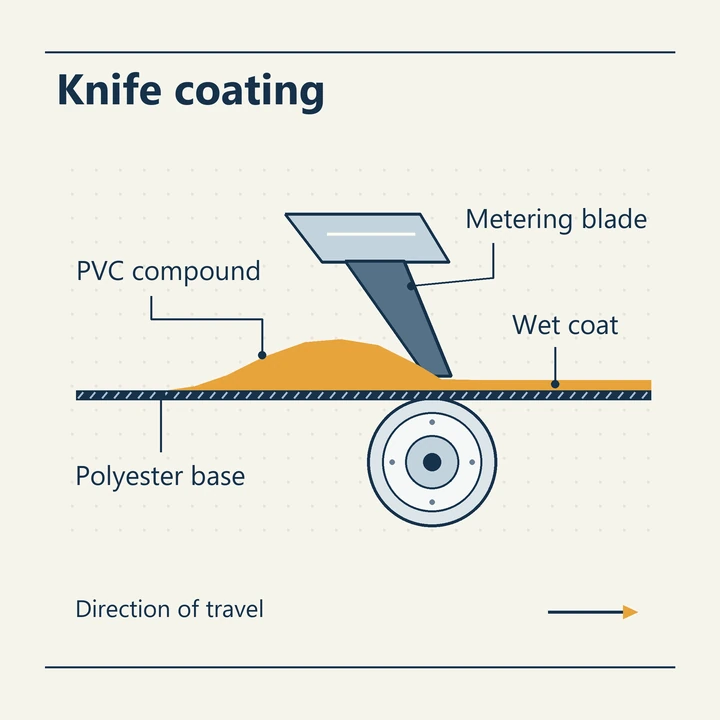
In knife coating, a blade meters a PVC compound onto a supported textile base. Heating then gels and fuses the compound into a continuous PVC layer. For a buyer ordering rolls to make truck-cover panels, the coating bond, the base fabric, and the finish on the side being welded can affect how the material behaves in fabrication.
- Support the base
Guide the textile into the coating stage.
- Meter the coating
The blade controls how much PVC compound stays on the fabric.
- Gel and fuse the PVC
Heat forms a continuous coating bonded to the textile.
Process and purchasing checks
What the blade and oven do
- Support the textile base. The fabric is held steady as it moves through the coating stage. Its construction contributes to the way the finished sheet handles loads in each fabric direction.
- Meter the PVC compound. The blade controls how much compound is laid onto the fabric. The blade gap and the way the compound flows help determine coverage. The coating can be applied to both faces when the grade calls for that construction.
- Heat the coating. The applied compound gels and fuses during heating. The resulting layer is bonded to the textile, which gives the sheet its reinforcement. Depending on the grade, finishing takes place before the sheet is wound into rolls.
Read the test results that matter for your panels
| What you are checking | What to ask for |
|---|---|
| Whether the PVC stays bonded to the textile | Coating adhesion results for the quoted grade, with the test method |
| How the sheet responds to pulling and to an existing cut | Tensile and tear results, with the two fabric directions identified |
| Whether the chosen faces form a usable seam | A sample in the ordered finish for a trial seam on your own equipment |
Keep the three checks separate when comparing quotes. A tensile test on a flat specimen answers a different question from a peel test on the coating. For a seam, put the overlap in the same orientation you will use in production. If a finished panel folds at a reinforced edge or rubs against a fitting, include that detail in the sample rather than relying on a flat seam alone.
How to read the DLT-5701 test methods
The DLT-5701 roll specifications list a finished weight of 610 g/m², a polyester base with PVC coating on both faces, and glossy and matte options. The test methods listed are DIN 53357 for coating adhesion, DIN 53354 for tensile strength, and DIN 53356 for tear strength.
All three are withdrawn DIN standards. If your order requires a current test method or results for a specific lot, ask for the report for that lot. Check the method and edition on the report, and confirm which fabric direction each tensile and tear result represents before comparing values.