
Tarp Thickness Chart: Mil to mm for PVC Tarp Rolls
Convert mil to millimeters and compare thickness and tolerance on PVC tarp quotes.
A 20 mil tarp is 0.508 mm thick. A 30 mil tarp is 0.762 mm thick. To compare two PVC tarp quotes, convert the figures to the same unit and check whether both describe the finished material, including its reinforcement and coating. Keep the quoted tolerances next to the nominal values when you compare them.
Convert tarp thickness from mil to mm
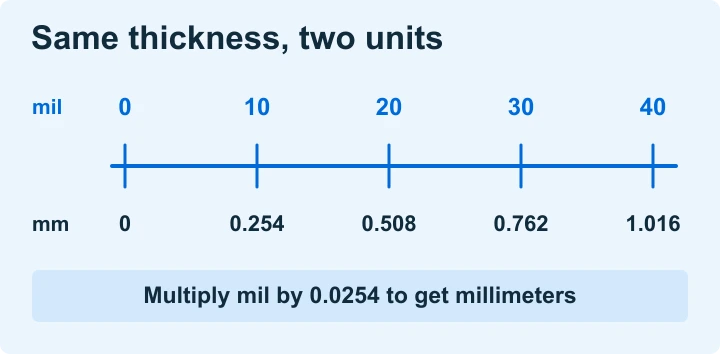
A mil is one thousandth of an inch. One inch is exactly 25.4 millimeters, so 1 mil = 0.0254 mm. Multiply mil by 0.0254 to get millimeters. Divide millimeters by 0.0254 to get mil.
| Nominal thickness (mil) | Equivalent (mm) |
|---|---|
| 10 | 0.254 |
| 12 | 0.3048 |
| 15 | 0.381 |
| 18 | 0.4572 |
| 20 | 0.508 |
| 24 | 0.6096 |
| 25 | 0.635 |
| 30 | 0.762 |
| 35 | 0.889 |
| 40 | 1.016 |
The chart converts units. Treat the numbers in the right column as arithmetic equivalents and use the supplier's stated tolerance to decide whether the material fits.
Compare the whole spec with the thickness
Thickness describes the distance between the two faces of the material. Grams per square meter (g/m²) and ounces per square yard (oz/yd²) describe mass per unit area. On reinforced PVC tarp rolls, the base fabric and coating both contribute to the finished construction. Ask for thickness and mass per unit area as separate fields so the team can compare quotes on both measures.
If a spec says “20 mil PVC,” ask which part was measured. For a reinforced sheet, confirm whether the number is for the finished composite or for a face layer. On textured material, ask where the supplier measures and what instrument and test method it uses. When applying an acceptance limit, agree on the measurement procedure with the supplier before checking incoming rolls.
Use the nominal figure and tolerance together
Consider a quote for 20 mil and a second quote for 0.50 mm. The nominal figures differ by 0.008 mm. To tell whether the two offers overlap, ask for the thickness tolerance or allowed range on each quote. Put both ranges in the same unit, then compare them with the minimum or maximum your job allows.
For a real data-sheet example, the DLT-5208 PVC tarp lists 0.75 mm, which converts to about 29.5 mil. That conversion expresses the listed thickness in another unit. If your purchase specification calls for a firm 30 mil minimum, ask for the agreed lower limit and documentation for the quoted grade before approving the order.
Record what matters to your cut and assembly
Write the finished-sheet thickness, the unit and the tolerance on the quote request. Add usable roll width and length if the material must fit an existing cutting pattern. If the sheet must fold into a pocket or pass through a fixture, test an actual sample using the relevant production setup.
For the remaining fields, use the PVC tarpaulin data sheet checklist to compare construction, strength test methods and roll dimensions before you approve the grade.